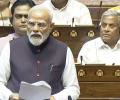
Prime Minister Narendra Modi addresses the Rajya Sabha, detailing India's strategies to navigate the global energy crisis sparked by the West Asia conflict, including securing diverse energy sources and expanding strategic oil reserves.

Saudi Arabia and the UAE are actively pushing Trump to take the war to its bitter finish and 'erase' Iran's presence in the geopolitics of the region. Simply put, the two most powerful Sunni Arab oligarchies are on the same page as Israel. Such interference increases the risk of a breakdown in dialogue between the US and Iran, points out Ambassador M K Bhadrakumar.

Amidst the stalling of high-level peace talks between Tehran and Washington, Iran continues to endure severe digital isolation as the nationwide internet blackout reached its 44th day on Sunday.

In a region increasingly shaped by competition and coercion, such collaboration strengthens security without confrontation, builds capacity without dependency and promotes order without domination, points out Dr Kumar.

'US and Iran have not annulled the ceasefire, and the possibility of continuing negotiations remains open.'

External Affairs Minister S Jaishankar addressed the Rajya Sabha on India's position regarding the escalating conflict in West Asia, emphasising the need for peace, dialogue, and the safety of civilians, while also prioritising India's energy security and trade interests.

Sonia Gandhi has criticised the Modi government's silence on the assassination of Iran's Supreme Leader, arguing it raises doubts about India's foreign policy direction and credibility.

Iran has reiterated that key preconditions must be met before negotiations with the United States can begin to resolve the conflict in West Asia, including a ceasefire in Lebanon and the release of blocked Iranian assets.

At least eight civilians have been reported killed, and 95 others have sustained injuries following United States-Israeli strikes, Iranian state media Press TV reported.
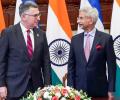
India and Israel on Tuesday signed a defence pact that will facilitate sharing of advanced technologies and promote co-development and co-production of key weapon systems and military hardware, in a major move to further bolster their already robust strategic ties.

Chinese Foreign Minister Wang Yi on Friday met Pakistan Army Chief Asim Munir and discussed regional security, counter-terrorism and matters of mutual interest.

India and Canada solidify their partnership with a landmark uranium supply agreement and discussions to finalise a comprehensive economic partnership, signaling stronger ties and cooperation on key global issues.

Amidst escalating tensions in West Asia, Pakistan's defence chief visited Saudi Arabia to discuss regional security and the mutual defence pact between the two nations, focusing on de-escalation strategies.

Prathichaya has timely ideas and an interesting moral core, but is weighed down by dated storytelling, predictable plotting, and uneven performances, notes Sreeju Sudhakaran.
India addresses the escalating conflict in West Asia, outlining its diplomatic efforts to ensure energy security, the safety of its citizens, and advocating for a peaceful resolution through dialogue.

The Indian government informed Parliament that India and the US are engaged in negotiations for a mutually beneficial multi-sectoral bilateral trade agreement. The two countries also cooperate on strategic, economic, and defense matters, managing divergences through high-level dialogues.

The Bangalore Chamber of Industry and Commerce (BCIC) has welcomed the Karnataka Budget 2026-27, highlighting its focus on economic growth, support for MSMEs, and infrastructure development. Industry leaders have expressed optimism about the budget's potential to boost manufacturing, create jobs, and drive innovation in the state.
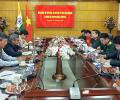
The 15th India-Vietnam Defence Dialogue signalled a move from routine talks to deeper cooperation, with new deals on submarine rescue and defence industry to support stability in the Indo-Pacific, notes Dr Rajaram Panda.

External Affairs Minister S Jaishankar affirms India's self-determined and 'unstoppable' rise, emphasising the nation's strategic growth and role in the Indian Ocean region amid evolving global dynamics.

The US torpedo attack on the Iranian warship IRIS Dena in international waters was a lawful act of war between belligerents, not a diplomatic or strategic embarrassment for India, asserts Vice Admiral Biswajit Dasgupta (retd).

India and the European Union have finalized a comprehensive mobility pact that will create new opportunities for Indian students and professionals in Europe. The agreement was reached during summit talks between Prime Minister Narendra Modi and top EU officials.
The Open Quantum Institute, a joint initiative by GESDA and CERN, aims to ensure that quantum computing is accessible to all when it becomes widely available, fostering global collaboration and capacity building.

For weeks, the war skirted the edge of catastrophe without tipping over. Missiles flew, there was much destruction, commanders were assassinated, cities across the Gulf and even in Israel struggled to absorb the shock. But one line held: Energy infrastructure, the arteries of the global economy, remained largely untouched. That is no longer true. Prem Panicker continues his must read daily blog on the Gulf War.
The Open Quantum Institute (OQI), a joint initiative by Geneva Science and Diplomacy Anticipator (GESDA) and CERN, aims to ensure equitable access to quantum computing when it becomes widely available, fostering international cooperation and addressing societal implications.
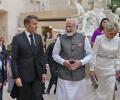
India-France synergy is poised to open vistas of collaboration between the two countries, notes Rup Narayan Das.
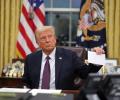
US President Donald Trump signed the National Defence Authorisation Act for Fiscal Year 2026 into law, highlighting broadened engagement with India and addressing the challenge posed by China in the Indo-Pacific region.

The 'rescue' operation occurred within kilometres of Iran's underground tunnel complex at Isfahan, assessed by the IAEA and US intelligence as holding a substantial portion of the country's 60 per cent enriched uranium stockpile. Retired senior US military officers have highlighted that the mission's footprint -- hundreds of special operators, multiple heavy-lift aircraft deep inside Iran -- appears outsized for recovering a single airman. Prem Panicker continues his must read blog on the Iran War.

If you are willing to spare four hours of your day on a spy action thriller, Dhurandhar The Revenge will surprise, shock and overwhelm you with its nervous energy, notes Divya Nair.

United States President Donald Trump on Saturday threatened to impose tariffs on Denmark and several European countries unless they agree to sell Greenland to the United States, framing the move as a national security imperative amid Chinese and Russian interest in the territory.

Canadian Prime Minister Mark Carney on Tuesday warned that the world is witnessing a fundamental 'rupture' in the global order rather than a gradual transition, cautioning against weaponising trade, finance, and supply chains.

Israel and the United States had a plan. Iran punched back. And now the Gulf is reeling, the world is beginning to feel the pain and, as on date, no one in Washington or Tel Aviv appears willing to admit that the punch has landed, notes Prem Panicker, continuing his must-read blog on the war in the Middle East.

Relations with India experienced a downturn during Yunus's tenure, while ties with Pakistan saw positive developments.
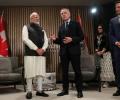
The statement suggests that Canadian authorities do not see ongoing foreign interference or violent activity tied to India at present.

'TTP has vowed to take revenge for the attacks that Pakistan is carrying out against Afghanistan.' 'To diminish this threat, Pakistan is hitting Afghanistan hard.'
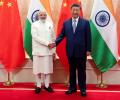
Senior officials from India and China's foreign ministries met in Beijing to discuss bilateral ties following a meeting between Prime Minister Modi and President Xi.

Russia and China on Saturday condemned the United States airstrikes on Venezuela and the capture of its president, Nicolas Maduro and his wife.
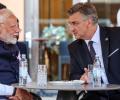
In his media statement following talks with his Croatian counterpart Andrej Plenkovic, Modi said both leaders agree that "terrorism is an enemy of humanity" and is inimical to forces that believe in democracy.
An influential US lawmaker claims his visit to India helped catalyze "early signals" that New Delhi may reduce its imports of Russian oil, a step he described as "meaningful" in weakening Moscow's ability to fund its war in Ukraine.
This will be the first meeting of the strategic dialogue between India and China and the main focus will be the big global issues.
There is no official word on India's level of participation at the deliberations related to the summit.
